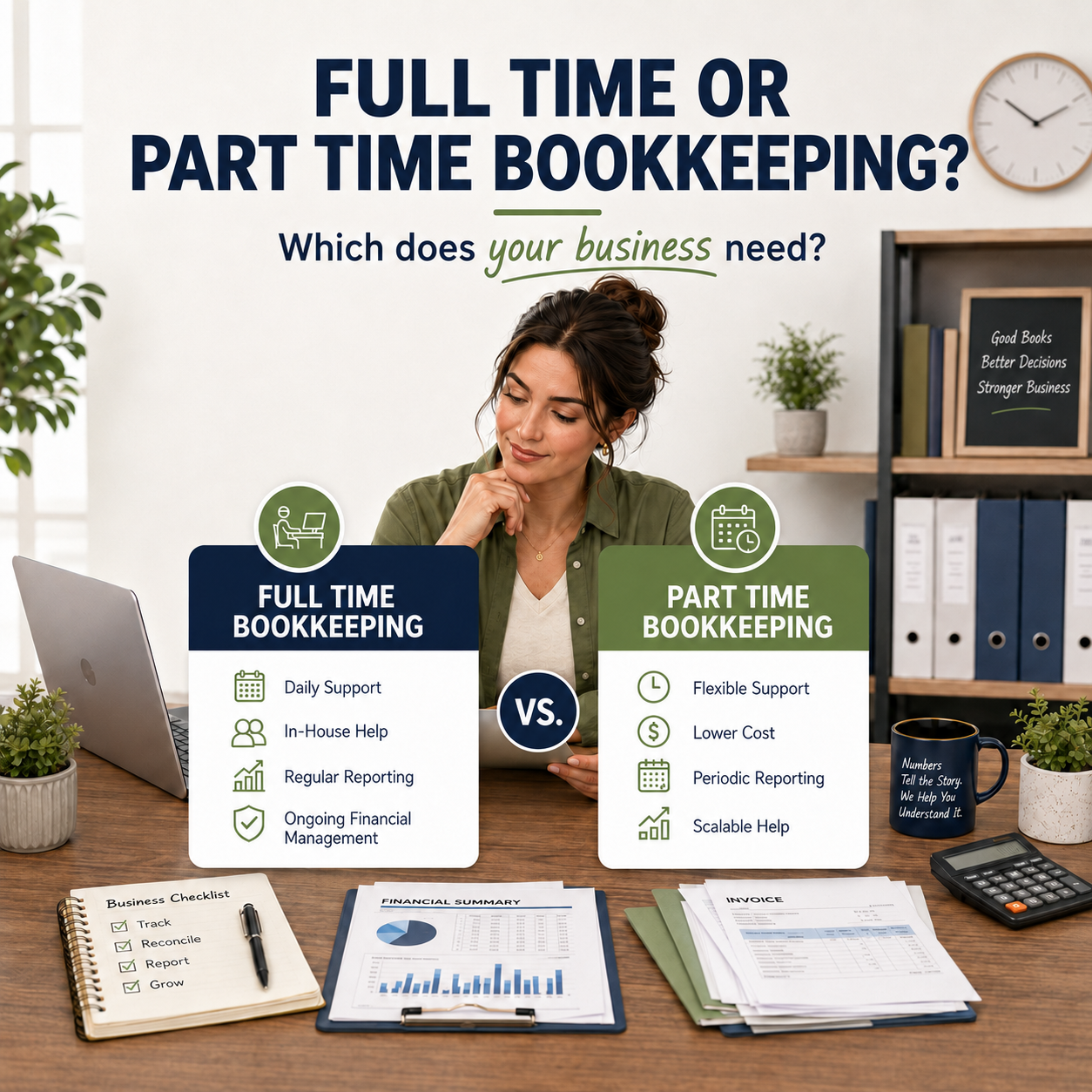
Full Time or Part Time Bookkeeping: Which Does Your Business Need?
Full time or part time bookkeeping should be chosen according to your transaction volume, payroll demands, reporting deadlines and need for daily support, not by business size alone. Part time or outsourced support suits many small businesses, while full time capacity becomes useful when financial administration is constant and closely connected to daily operations.
Choose bookkeeping capacity by looking at workload, timing and the level of support your business needs.
The right choice is less about a neat headcount rule and more about what happens inside your accounts each week. A business with a small team can still have complex payroll, multiple payment channels and demanding reporting needs. A larger business with clean systems and predictable transactions may need fewer bookkeeping hours than expected.
Start by defining the work, the frequency and the response time your business needs. Then decide whether an employed bookkeeper, a part time arrangement or professional bookkeeping services provide the best fit.
What is the practical difference between full time and part time bookkeeping?
The practical difference is the amount and timing of capacity available to your business. A full time bookkeeper is generally available throughout the working week. A part time bookkeeper works an agreed schedule or service scope, which may range from a few hours each week to several set days.
If you are considering employment, the arrangement also affects workplace obligations. The Fair Work Ombudsman explains the general characteristics of full time employment and part time employment. Check the applicable award, agreement and professional advice before setting employment terms.
There is also a separate service model question. Your part time bookkeeping capacity could come from an employee, a contractor where the legal arrangement genuinely supports that classification, or an outsourced provider. The number of hours does not decide the legal relationship. It only describes the capacity you need.
When does part time bookkeeping make sense?
Part time bookkeeping makes sense when the work is recurring and important but does not require daily attention from one dedicated person. This is common for businesses with manageable transaction volumes, established systems and predictable weekly routines.
A part time bookkeeper can usually cover tasks such as:
Reconciling bank and credit card accounts on a set schedule
Processing or reviewing accounts payable and receivable
Maintaining accurate transaction coding and supporting records
Preparing payroll information and checking payroll records
Keeping records organised for BAS and accountant handover
Producing regular reports for owner review
This model can provide flexibility as workload changes. It also encourages the business to agree on priorities, cut off times and communication routines. That structure matters because a part time arrangement can fail when every request is treated as urgent or when documents arrive too late for the agreed processing window.
A clear schedule helps part time bookkeeping support remain reliable as the business grows.
When does a full time bookkeeper make sense?
A full time bookkeeper makes sense when financial administration is continuous, time sensitive and closely tied to everyday operations. The case becomes stronger when one person can remain productively occupied across the week and when delays would disrupt staff, suppliers, customers or management decisions.
Signals that full time capacity may be justified include:
High daily transaction volume across several accounts or sales channels
Frequent payroll activity, staff changes or complex payroll administration
Large accounts payable and receivable workflows that need regular follow up
Multiple entities, locations, departments or reporting streams
Daily cash flow monitoring and rapid management reporting
Constant coordination with operations, managers and external advisers
Full time availability can improve continuity and response times, but capacity alone does not guarantee clean records. The business still needs documented processes, suitable software, review controls and clear responsibility for approvals. It should also plan for leave, training and continuity when the bookkeeper is unavailable.
If payroll is one of the main workload drivers, review the scope of your payroll processes and support separately. Payroll urgency can create the impression that all bookkeeping needs daily coverage when a focused payroll solution plus scheduled bookkeeping may be enough.
How do full time, part time and outsourced bookkeeping compare?
The best model is the one that gives the business enough reliable capacity without paying for unused time or leaving critical work exposed.
Comparison of common bookkeeping support models
Consideration
Full time employee
Part time employee
Outsourced service
Availability
Regular weekday capacity
Agreed days or hours
Agreed service schedule and response times
Best fit
Continuous and integrated workload
Predictable recurring workload
Flexible scope or access to broader capability
Management
Direct supervision and employment processes
Direct supervision within a smaller schedule
Managed through scope, workflows and service communication
Continuity
Depends on one employee unless backup exists
Depends on schedule and backup planning
May offer team coverage, subject to the provider arrangement
Scaling
Capacity changes usually need role changes or recruitment
Hours may change by agreement
Scope may be adjusted with the provider
Do not compare only the hourly rate. Consider recruitment, onboarding, payroll obligations, supervision, software access, training, leave coverage, review time and the cost of delays or errors. For outsourced support, confirm what is included, how additional work is approved and who is responsible for each deadline.
How can you measure your bookkeeping workload?
Measure the real work for at least one normal month before committing to a model. A clean workload review is more useful than estimating from memory because it captures recurring tasks, interruptions and month end peaks.
List every recurring task. Include reconciliations, invoices, bills, payroll, document collection, reporting and follow up.
Record frequency and deadlines. Note what is daily, weekly, monthly and tied to an external due date.
Estimate active processing time. Separate real work from waiting for approvals, documents or answers.
Identify peak periods. Include payroll days, month end, BAS preparation and seasonal trading changes.
Mark work that needs business context. Some decisions require close access to managers, while routine processing may not.
Add review and backup time. Reliable bookkeeping includes checking, correction and continuity planning.
This review often shows that the business needs better workflow design rather than a larger role. Missing documents, unclear approvals and inconsistent coding can inflate the workload. Fixing those bottlenecks can make part time or outsourced bookkeeping more effective without reducing control.
Measure transaction work, deadlines and review time before choosing the level of bookkeeping support.
Should your bookkeeper be employed or outsourced?
Choose employment when the role needs close daily integration, direct supervision and enough stable work to support the arrangement. Choose outsourced bookkeeping services when flexibility, defined deliverables and access to broader backup capability matter more than having one person inside the business every day.
Ask these questions before deciding:
Does the work require daily access to operational decisions?
Can tasks be grouped into reliable processing schedules?
Who approves payments, payroll changes and unusual transactions?
What response time is genuinely required?
Who provides coverage during leave or unexpected absence?
How will secure access and document exchange be managed?
What reporting does management need and how often?
Bookkeeping and accounting responsibilities should also be separated clearly. The public guide on choosing between a bookkeeper and an accountant explains the different roles. Your chosen bookkeeping capacity should complement the work of your accountant rather than duplicate it.
How do you make the final decision?
Choose the smallest model that can meet your deadlines reliably, maintain accurate records and provide the reporting visibility management needs. Build in a review point so the arrangement can change when transaction volume, staffing or business complexity changes.
A practical decision process is:
Define the required tasks and service standards
Measure normal and peak workload
Separate urgent work from work that can be scheduled
Compare the full operating cost of each model
Confirm responsibility, access controls and backup coverage
Review performance after an agreed settling period
If management reports are regularly late or difficult to trust, include that in the decision. Reliable financial reporting and analysis depends on accurate, timely bookkeeping. The correct support model should improve both record quality and the usefulness of the numbers.
Frequently asked questions
How many hours should a part time bookkeeper work?
There is no universal number of hours. Start with the tasks, transaction volume, payroll schedule, reporting deadlines and time needed for checking. Review actual hours after a normal operating month. The right arrangement should cover routine work and peak periods without creating unused capacity or repeated deadline pressure.
When should a small business hire a full time bookkeeper?
A full time bookkeeper becomes worth considering when financial administration creates productive work across most of the week and needs close daily coordination. High transaction volume, frequent payroll, large debtor and creditor workflows, multiple entities and rapid reporting needs are stronger signals than employee count by itself.
Can outsourced bookkeeping replace a part time employee?
Outsourced bookkeeping can cover many recurring tasks when responsibilities, response times, access and approval workflows are clearly defined. It may also provide flexible capacity and backup. It is not automatically the best choice for work that requires continuous onsite coordination, immediate operational decisions or direct supervision throughout each day.
Is full time bookkeeping always more expensive?
Do not compare the headline rate alone. Compare recruitment, employment obligations, supervision, software, training, leave coverage and unused capacity with the complete outsourced service scope. The better value is the model that delivers accurate records, dependable deadlines and useful reporting with the least avoidable rework and disruption.
Can a business start part time and move to full time later?
Yes. Many businesses begin with scheduled part time or outsourced support and increase capacity as transactions, payroll and reporting needs grow. Set review triggers in advance, such as persistent backlogs, missed cut off times, slower reporting or a sustained rise in weekly processing hours, so the decision is evidence based.
Choose bookkeeping capacity that fits the work
Full time or part time bookkeeping is a capacity decision, not a status decision. Start with the work your business must complete, the timing it requires and the level of continuity that protects accurate reporting. For many small businesses, structured part time or outsourced support is enough. Full time capacity makes sense when the workload is genuinely continuous.
i2 Bookkeeping can help you review the current workload and define a practical scope. Contact i2 Bookkeeping to discuss the level of support that fits your business. Live engagement terms and any employment structure should be confirmed separately with the appropriate professional advice.